Three Boxes for Three Sons
SNNPR
A Kafa Story
Before you read the story
- When a person dies, how can he or she fairly divide their property between their children?
- Is it right to give each child the same amount of property?
- Families sometimes quarrel about property left to them by their parents. Has this happened to anyone that you know?
Now read the story
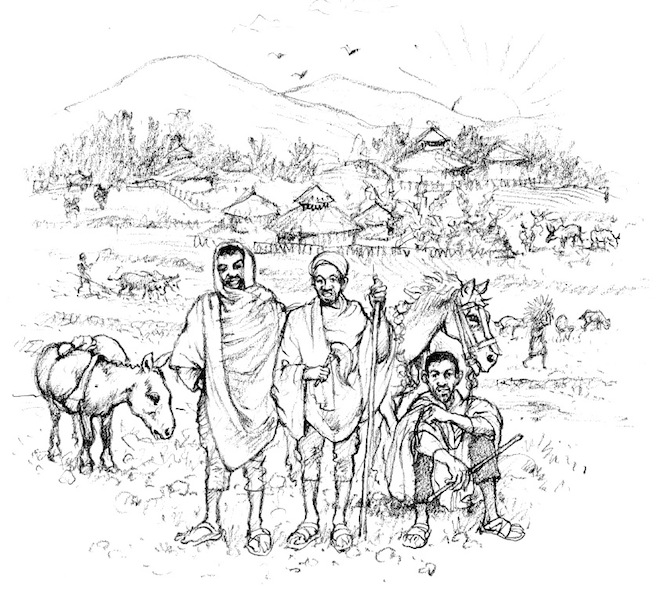
An old man had three sons.
"Soon I will die," he said to his friends. "I must make my will, and give my property to my children. Please, my friends, bring me three boxes."
His friends brought the boxes to him. The old man put soil in the first box. He put money in the second box, and jewellery in the third box. Then he closed the boxes. He wrote the name of one of his sons on each box, and gave them to his friends.
"When I am dead, give these to my sons," he said to them.
At last, the old man died, and his friends gave the boxes to his sons. The young men opened them.
"There's soil in my box," the first son said.
"And money in mine," said the second son.
"And I have jewellery in mine," said the third son.
"Why did our father give us these things?" they asked each other, but they could not find the answer.
"Let's go and visit the wise man," they said. "Perhaps he can help us."
The three brothers began to walk to the wise man's house. On the way, they passed a river. A crocodile was in a field near the river. It was licking water from the grass.
"What does this mean?" the brothers asked, but none of them could answer.
Soon they came to a beautiful valley full of green grass. A horse stood on the grass. It was very thin, but it did not eat.
"This is strange," the brothers said. "The horse is very thin. Why doesn't it eat the grass?"
The road passed through the valley and came to a desert. A fat donkey stood in the desert.
"Look at this donkey," said the brothers. "Why is he fat? This place is a desert. There is no grass here, and no water."
At last they arrived at the wise man's house. They showed him the three boxes.
"Your father was a good, clever man," the wise man said, "and his will is a good one. Here is its meaning."
He looked at the soil in the first brother's box.
"Your father's land is for you," he said. "Plough it. Plant seeds. Grow crops. Be a good farmer."
He looked at the money in the second brother's box.
"Your father gave you his money," he said. "Buy cows and sheep and goats. Look after your cattle well. Be a good herdsman."
He looked at the jewellery in the third brother's box.
"The goods of your father are for you," he said. "Sell them. Buy more goods and sell those. Be a good merchant."
The three brothers thanked him, and began to go.
"I have one more message for you from your father," the wise man said. "It is a promise. If you obey his will, you will all become rich, happy men."
The three brothers thanked the wise man again, and went home. The oldest brother took the land. He ploughed it, and sowed seeds, and grew good crops. He was a farmer.
The second brother took the money. He bought cows and sheep and goats. He became a herdsman.
The third brother took his father's goods. He sold them and bought more. He became a merchant.
But the three brothers were not rich, and they were not happy.
"I have land, but I have no goods and no money," the farmer thought. "Look at my fields! There is too much grass. Wild animals come and eat it. Then they eat my crops. "
Suddenly, he remembered the crocodile, licking the grass in the field by the river.
"Now I understand," he thought. "I don't want wild animals on my land. I want cattle. I will ask my brother to give me some."
The herdsman was unhappy too.
"I have many cows and sheep and goats," he thought, "but I don't have any land. My cattle are all thin."
He remembered the thin horse in the green valley.
"I understand its meaning now," he thought. "I need land for my cattle. I will ask my brother to give me some."
The merchant was thinking too.
"I have many goods," he said to himself, "and I travel with my donkeys to many places. But I have no house, and I live far away from my family."
He remembered the fat donkey in the desert.
"Yes," he thought. "I understand now. I will ask my brother for land. Then I will build a house and live near my family."
So the farmer gave some of his land to the herdsman, and the herdsman gave him some cattle. The merchant gave the farmer goods, and the farmer gave him land for his house. The three of them lived together happily. They helped each other, and they became rich.
When the wise man heard the news, he smiled.
"The old man was clever," he thought, "and his sons obeyed his will. They respected their father and learned from him, and now they are rich and happy."
Exercises
A. How much did you understand?
In the first part of this story, an old man is preparing to die.
Answer these questions.
- What did the old man ask his friends to bring him?
- What did the old man put in the first box?
- What did he put in the second box?
- What did he put in the third box?
- What did he write on the boxes?
In the second part of the story, the old man's sons went to see a wise man. On the way, they passed some strange things.
Answer these questions.
- Which animal did the brothers see in a field near the river?
- What was the animal doing?
- Which animal did the brothers see in a valley full of green grass?
- Which animal did the brothers see in a desert?
- The first brother was going to have the old man's land, and be a farmer. What did he find in his box?
- The second brother was going to buy cows and sheep and goats, and be a herdsman. What did he find in his box?
- The third brother was going to buy and sell goods, and be a merchant. What did he find in his box?
In the third part of the story, the brothers find that their lives are not easy.
Which brother is thinking each of these thoughts?
- "I will ask my brother for land. Then I will build a house and live near my family."
- "I have land, but I have no goods and no money."
- "I need land for my cattle. I will ask my brother to give me some."
- "I don't want wild animals on my land. I want cattle."
- "But I have no house, and I live far away from my family."
- "But I don't have any land. My cattle are all thin."
B. Who is speaking?
Who said these sentences?
- "I must make my will."
- "Let's go and visit the wise man."
- "The horse is very thin. Why doesn't it eat the grass?"
- "Your father was a good, clever man."
- "If you obey his will, you will all become rich, happy men."
C. Make a play
This story can make a good play. You can act the parts of the old man, his friends, his three sons and the wise man, as well as the crocodile, the horse and the donkey.
Teachers’ answer key
A. How much did you understand?
- What did the old man ask his friends to bring him?
Three boxes - What did the old man put in the first box?
Soil - What did he put in the second box?
Money - What did he put in the third box?
Jewellery - What did he write on the boxes?
The names of his sons
- Which animal did the brothers see in a field near the river?
A crocodile - What was the animal doing?
It was licking water from the grass. - Which animal did the brothers see in a valley full of green grass?
A horse - Which animal did the brothers see in a desert?
A donkey - The first brother was going to have the old man's land, and be a farmer. What did he find in his box?
Soil - The second brother was going to buy cows and sheep and goats, and be a herdsman. What did he find in his box?
Money - The third brother was going to buy and sell goods, and be a merchant. What did he find in his box?
Jewellery
- "I will ask my brother for land. Then I will build a house and live near my family."
The third brother – the merchant - "I have land, but I have no goods and no money."
The first brother – the farmer - "I need land for my cattle. I will ask my brother to give me some."
The second brother – the herdsman - "I don't want wild animals on my land. I want cattle."
The first brother – the farmer - "But I have no house, and I live far away from my family."
The third brother – the merchant - "But I don't have any land. My cattle are all thin."
The second brother – the herdsman
B. Who is speaking?
Who said these sentences?
- "I must make my will."
The old man - "Let's go and visit the wise man."
The three brothers - "The horse is very thin. Why doesn't it eat the grass?"
The three brothers - "Your father was a good, clever man."
The wise man - "If you obey his will, you will all become rich, happy men."
The wise man
For teachers — answers to the exercises above.